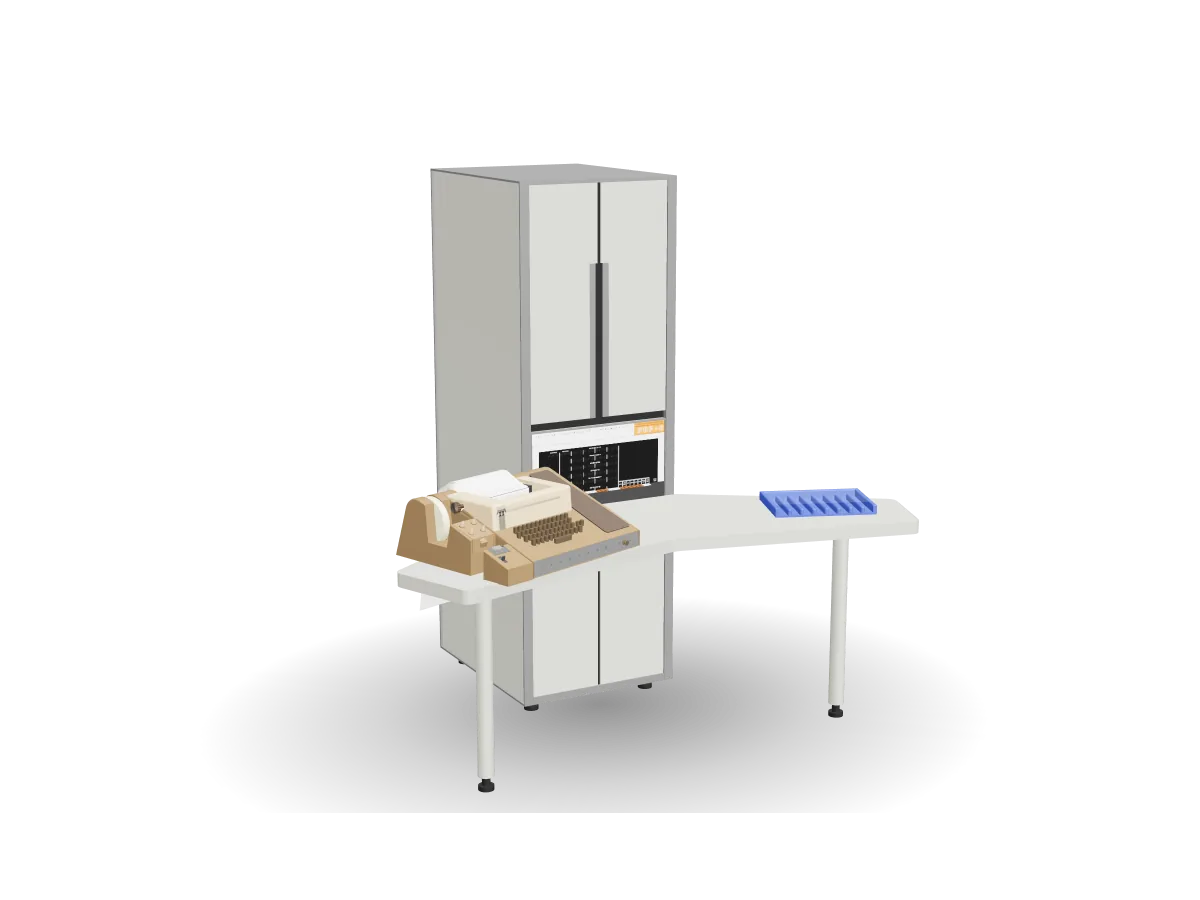
CHEKMO-II plays a full game of chess on a PDP-8 with 4,096 twelve-bit words of memory: the board, the rules, the search for a move and the conversation with you at the Teletype all fit in less space than this page's text. John E. Comeau, an engineer and instructor at DEC in Maynard, Massachusetts, wrote it in PAL-8 assembly language and gave it to DECUS, the users' society, where it was catalogued as DECUS 8-822. For most PDP-8 owners it was the chess program.
It runs on any machine of the PDP-8 family, and so on the 1965 original in this room.
Playing
CHEKMO-II is already in memory and started when you sit at the ASR-33. You play by typing your moves at the Teletype; the program answers with its own, printed on the paper. There is no board on a screen: like players of the time, keep the position on a real board beside you, or in your head.
Be patient. The PDP-8 runs a few hundred thousand instructions a second, and the emulator runs it at exactly its real speed, so on a hard position the machine thinks for a minute or more before it prints a move. That wait is part of the experience: it is what playing a computer felt like in the 1970s.
Why it matters
Chess was one of the first problems people set computers to show that they could "think", and by the early 1970s strong programs ran on large mainframes. CHEKMO-II shows how much of that could be squeezed into a small laboratory machine: careful assembly code, a compact board representation and a short search, trading strength for size.
In the classroom
CHEKMO-II is a good way to talk about limits. Ask how a chess program might fit the rules of chess into 4K words, what it has to leave out, and why it takes so long to reply; then compare with the phone in your pocket, which has about a million times more memory and runs many thousands of times faster.
More to try
For something you can win more easily, try Hammurabi or Lunar Lander.